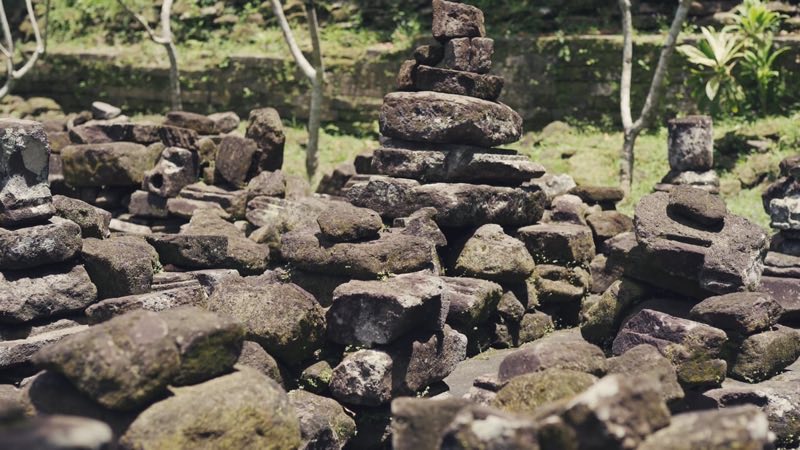

Goa Gajah, or Elephant Cave, near Ubud on the island of Bali, is believed to date to around the 9th to 11th centuries and likely served as a place of spiritual meditation, though its precise origins remain uncertain. Its entrance is cut into the rock face as a vast, glowering demonic head, its open mouth forming the doorway to a narrow T-shaped chamber lined with meditation niches. The complex blends Hindu and Buddhist imagery, including a lingam and yoni alongside carved stupas, and was rediscovered by Dutch archaeologists in 1923, with its bathing pools, fed by spouts held by stone figures, uncovered only in 1954. The site lies in a wooded river gorge, its terraces descending toward the water.