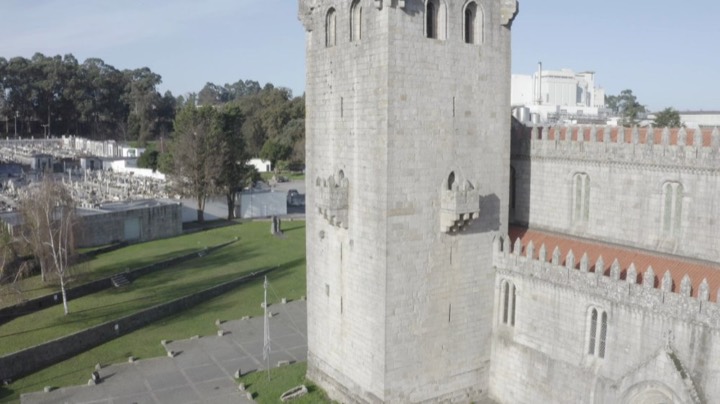

Porto Cathedral commands the terrace above the Douro from which the whole of the old city and the river bridges can be seen. Begun in the twelfth century, it was conceived as much as a defensive structure as a church, with heavy walls, a crenellated parapet and two square towers flanking a rose window, and it retains that severity despite everything added since. The Gothic cloister was built in the fourteenth century and later covered with eighteenth-century blue and white azulejos illustrating biblical scenes; a Baroque loggia and a granite staircase were added by the Italian architect Nicolau Nasoni, whose work marks the city throughout. In the chapel of the Blessed Sacrament stands a silver altarpiece said to have been concealed behind a plaster wall to save it from Napoleonic troops. Within the historic centre of Porto inscribed on the UNESCO World Heritage List, the cathedral offers a compact reading of Portuguese architecture from the Romanesque to the Baroque.