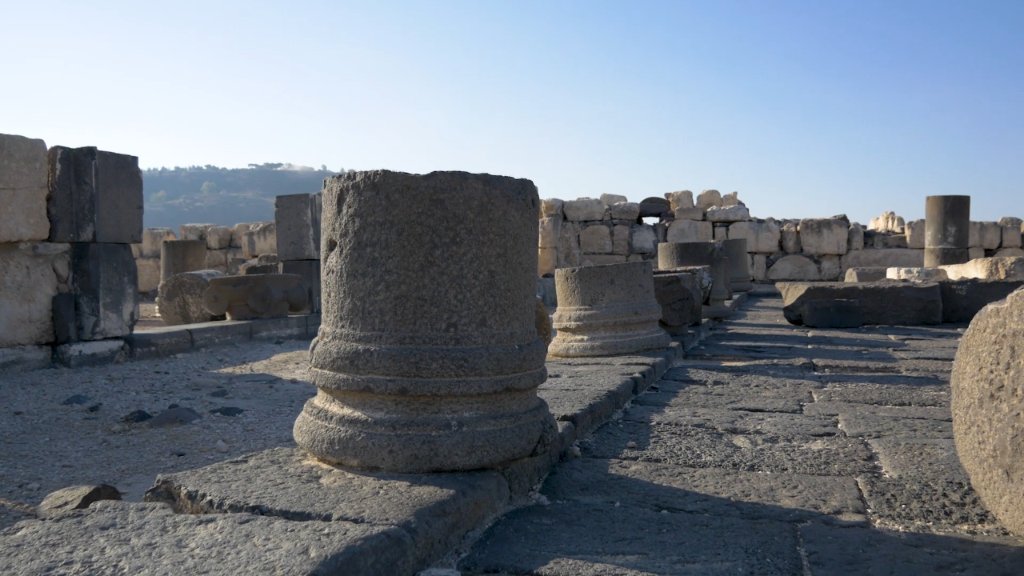

Hippos, known in Aramaic as Sussita, occupies a natural acropolis rising sharply from the eastern shore of the Sea of Galilee. A city of the Decapolis, it belonged to the Greek-speaking urban world that surrounded Jewish Galilee, and its plan is that of a classical city transposed onto a mountain top: a colonnaded main street running the length of the ridge, public buildings, a forum, and later a series of Byzantine churches with mosaic floors and marble fittings. Excavation has been continuous here for years, and the site is unusually legible — the columns lie where they fell, aligned by the earthquake that brought the city down and after which it was not rebuilt. That single catastrophic moment, frozen in the ground, is the site's most cinematic feature. The film sets Hippos against the lake below, where the Christian sanctuaries of the Galilee shoreline are visible from the summit, illustrating how closely Greek civic culture, Jewish villages and early Christian communities lived within sight of one another. Aerial photography carries the scale of the ridge and its approach.